
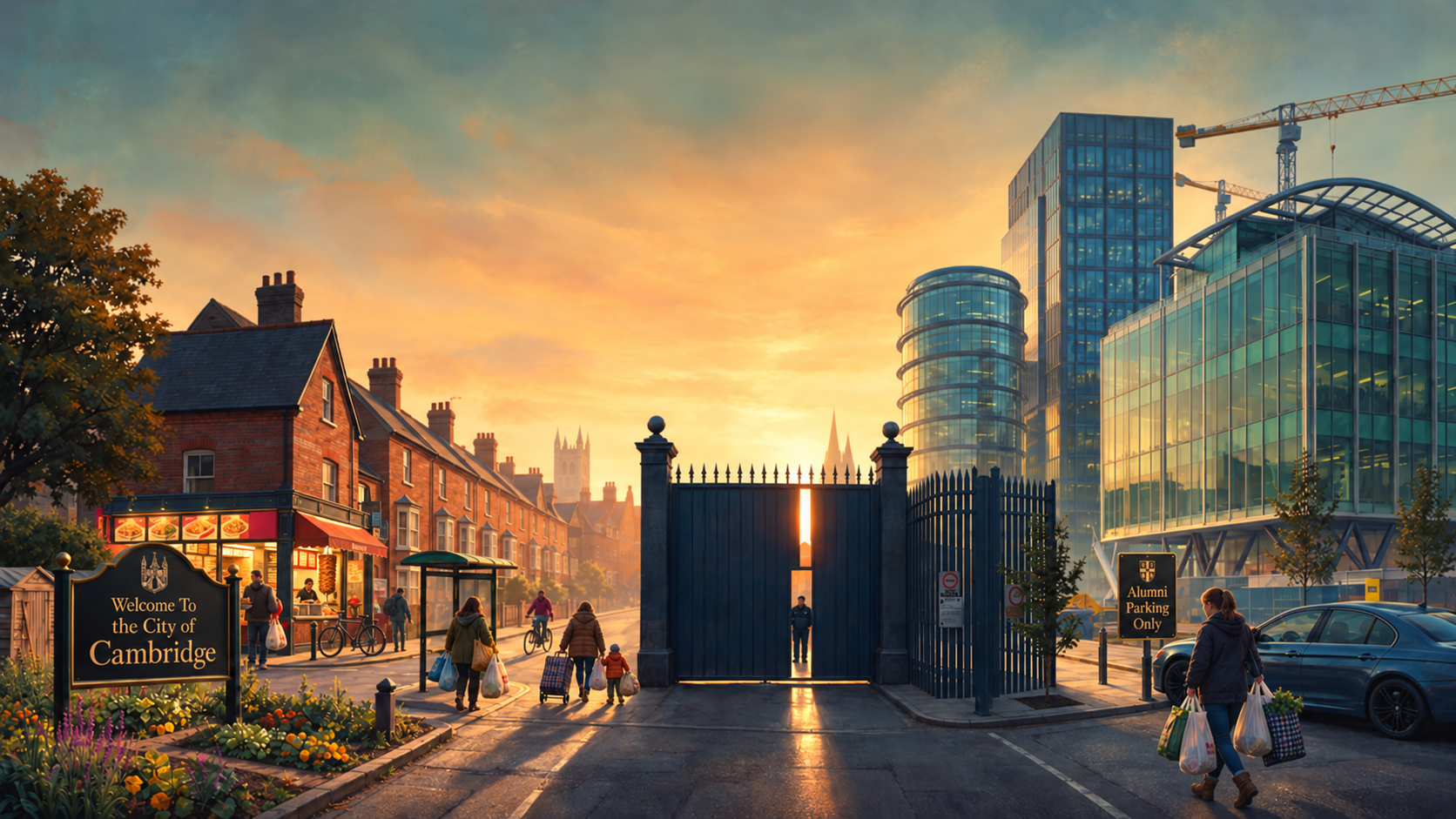
How Technocracy and Corporate Greed Broke the Soul of Cambridge
Cambridge is booming. The laboratories are expanding, the investors are celebrating, and the property developers are prospering. But what happened to the people who made the city what it was?
I Helped Build This City. Now I Barely Recognise It
I am not an outsider throwing stones at progress. I was once part of the very industry that helped create the modern Cambridge Phenomenon.
As a technology entrepreneur, I started and ran businesses in Cambridge. My connection to the city stretches back more than fifty years, from junior school in a South Cambridgeshire village in the 1970s to senior school in Newnham, and subsequently living in King Street, Chesterton, Newmarket Road, Trumpington, Sturton Street and, for fourteen years, Mill Road.
I knew a Cambridge that was vibrant, quirky, independent and, above all, a place where ordinary people could belong.
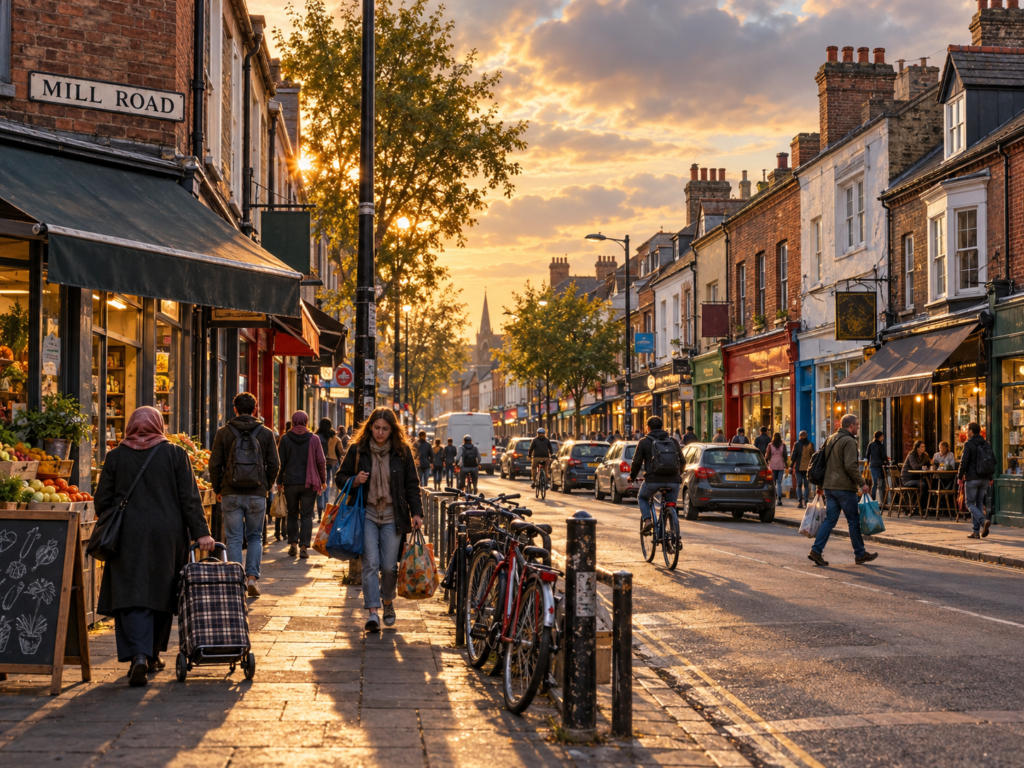
It wasn’t perfect. No city is. But it had something that seems increasingly absent today.
It had a soul.
In 2018, following a debilitating illness, my city accommodation was no longer suitable for my needs. I found myself unable to secure appropriate housing in the city I had called home for decades.
I ended up back in a South Cambridgeshire village.
There was a bitter irony in discovering that a city celebrated internationally for its innovation, wealth and intellectual brilliance had so little room for somebody whose circumstances had changed.
Apparently, Cambridge welcomes disruption. Just not the kind that happens to people’s lives.
Mill Road: From Community to Corridor
For years after leaving, I followed developments around my former home through friends, local news and social media.
I watched the arguments surrounding the Greater Cambridge Partnership, active travel schemes and the repeated battles over Mill Road bridge.
The promises were seductive: cleaner air, safer cycling, reduced congestion and a more pleasant urban environment.
Who could possibly object?
But on a recent return visit to Mill Road, I was genuinely upset by what I encountered.
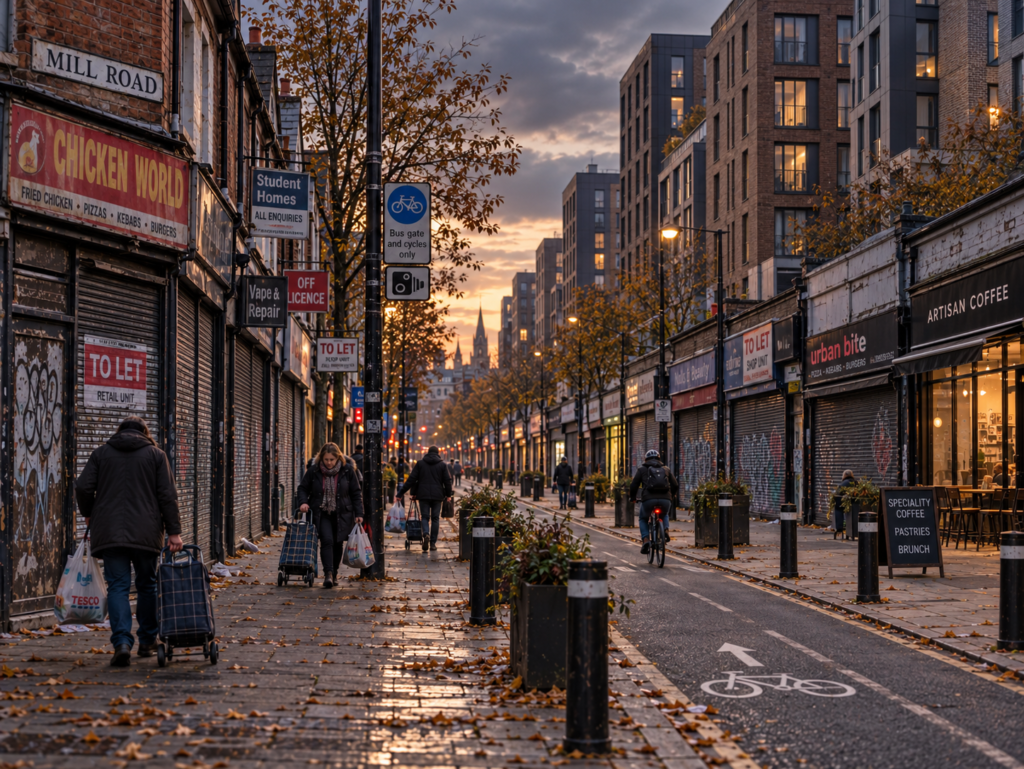
The bustling, wonderfully chaotic community I remembered felt diminished. Familiar independent businesses had disappeared. Parts of the street seemed tired, subdued and disconnected from the lively commercial ecosystem I once knew.
Of course, businesses close for many reasons. Rents, business rates, online shopping, changing consumer habits and the wider economic climate all take their toll.
But restricting how people reach a shopping street cannot simply be dismissed as irrelevant to its economic survival.
And some traders are making precisely that complaint.
In July 2026, the manager of Al-Amin Stores described the impact of the Mill Road bus gate on footfall as devastating. Other traders have disputed how much blame the restrictions deserve.1Greatest Hits Radio, 7 July 2026, reporting concerns from Mill Road traders: https://www.hellorayo.co.uk/hits-radio/cambridgeshire/news/shop-manager-fears-bus-gate-destroyed-mill-road-cambridge . See also the contrasting account from Relevant Records, 23 May 2026: https://www.hellorayo.co.uk/greatest-hits/cambridgeshire/news/cambridge-music-shop-on-mill-road-bus-gate
The bridge restrictions have been enforced through a bus gate since 2025. Although buses, taxis, registered Blue Badge vehicles and certain other authorised vehicles are exempt, ordinary through-traffic is prohibited.2Cambridgeshire County Council, Mill Road bridge Traffic Regulation Order and exemption arrangements: https://www.cambridgeshire.gov.uk/residents/travel-roads-and-parking/transport-projects/cycling-pedestrian-improvements/mill-road-bridge-tro
The council points to public support for restrictions and promises a review of their effects in 2027.
But surely the success of a transport policy must be measured by more than a reduction in motor vehicles?
What about the shops, the livelihoods, the elderly customers, the people travelling from surrounding villages and those whose lives cannot conveniently be conducted on two wheels?
A street is not successful simply because it has fewer cars. It is successful when it serves the community around it.
Town Versus Gown: The New Land Grab
Cambridge has always had a complicated relationship between its university, its commercial interests and the people who actually live there.
The historic tension between town and gown is nothing new. What has changed is the sheer scale of the money involved.
Cambridge is now an internationally important centre for biotechnology, research, pharmaceuticals, artificial intelligence and advanced engineering. Research parks and laboratory developments compete for increasingly valuable space.
Investment in research is not inherently bad. I spent much of my working life in technology businesses, and I understand perfectly well the economic value of innovation.
But there is a question nobody seems particularly keen to confront:
Who is Cambridge actually being developed for?
The planning system increasingly encourages developments designed around cycling, walking and public transport rather than private vehicles.3Greater Cambridge Shared Planning, Sustainable Transport and Connectivity policy: https://consultations.greatercambridgeplanning.org/draft-greater-cambridge-local-plan-consultation/infrastructure/policy-ist-sustainable-transport-and
There are sound environmental reasons for doing this.
But there is also a danger that policies promoted as environmentally progressive can become extraordinarily convenient for well-funded institutions seeking to intensify development in an already overcrowded city.
A laboratory employing hundreds of people does not cease to generate transport demand merely because its planning application contains few car parking spaces.
Its employees still need to travel. Equipment still needs delivering. Buildings still require maintenance. Waste still needs collecting. Contractors still need access.
And the people providing these services increasingly live outside Cambridge because they cannot afford to live within it.
If the planning system measures success primarily through reduced parking provision and predicted changes in commuting behaviour, it risks overlooking the less glamorous realities of making a city function.
You cannot build a functioning city entirely around the commuting preferences of its best-paid residents.
The Greater Cambridge Partnership was established to help deliver transport and infrastructure improvements alongside economic growth. Yet the relationship between growth, public investment and private development deserves far more scrutiny.
Are taxpayers financing the infrastructure that makes increasingly valuable commercial developments possible, while ordinary residents experience the disruption and exclusion?
That is a legitimate question, and one the public deserves to have answered.
The Bicycle Is Not the Enemy. The Blind Spot Is.
Before anybody accuses me of being some sort of anti-cycling dinosaur, allow me to explain something.
Over five decades, I have travelled around Cambridge on foot, by bicycle, motorcycle, car, bus and taxi. I have driven vans and towed trailers through its streets.
I understand the city from considerably more perspectives than just behind a steering wheel.
I actually like cycling.
What I object to is the increasingly fashionable idea that the bicycle represents a universal transport solution.
It doesn’t.
A bicycle is wonderful for a fit student making a short journey to lectures, or a research worker travelling to a laboratory with a laptop.
It is somewhat less useful to an electrician carrying tools, a plumber transporting equipment, a delivery driver supplying a shop or a care worker visiting vulnerable people across a dispersed rural county.
And for many disabled people, cycling simply isn’t an option at all.
Yes, accessible bicycles and adapted cycles exist, and they are valuable for those who can use them. But accessibility is about providing genuine choice, not assuming everybody can adapt to the transport preferences of somebody else.
For those of us living in South Cambridgeshire villages, the car can be a lifeline rather than a luxury.
A functioning transport system needs to accommodate all these different realities.
Instead, too much of the debate seems to reduce people to convenient categories.
Cyclists are virtuous. Motorists are the problem.
The real world is rather more complicated.
The irony is that many of the highly paid professionals enjoying Cambridge’s increasingly exclusive environment depend upon tradespeople, cleaners, delivery drivers, carers and maintenance workers who cannot afford to live anywhere near them.
Those workers must travel into the city to provide the services everyone else takes for granted.
Cambridge wants the labour. It just seems increasingly reluctant to accommodate the people providing it.
Social Housing: Who Gets to Call Cambridge Home?
Perhaps nowhere is this contradiction more visible than in the city’s housing policies.
Cambridge’s extraordinary property values have made buying a home increasingly unrealistic for ordinary working households. Social housing should offer an alternative.
Yet even established council estates are not immune from redevelopment.
Consider Ekin Road.
The council’s redevelopment plans propose replacing 91 existing council homes and 17 private homes with 78 new council homes and 56 private homes.
That means 13 fewer council homes on the Ekin Road site itself.4Cambridge City Council, Ekin Road redevelopment proposals, 6 October 2026: https://cambridge.gov.uk/news/2026/10/06/proposals-to-redevelop-ekin-road-with-fit-for-the-future-council-homes-progress-to-planning
The council argues that the new properties will provide larger, more energy-efficient accommodation and house approximately the same number of people. It also points to additional council housing elsewhere in the Abbey area.
Those arguments deserve consideration. Nobody should have to live in damp, structurally defective or unsuitable accommodation simply to preserve old buildings.
But they do not eliminate the uncomfortable questions.
Why should an established council estate have fewer council homes after redevelopment?
What happens to the existing community while the work takes place? Can displaced tenants realistically return?
And when councils describe new housing as affordable, what exactly does that mean to a family whose income bears little resemblance to the salaries paid in Cambridge’s technology sector?
In March 2025, concerns raised at the council’s Housing Scrutiny Committee included difficulties faced by Ekin Road households seeking suitable alternative accommodation, particularly larger family homes.5Cambridge City Council, Housing Scrutiny Committee, 11 March 2025, including residents’ questions concerning relocation and replacement accommodation: https://democracy.cambridge.gov.uk/ieListDocuments.aspx?CId=414&MId=4464&Ver=4
There is a profound difference between creating more housing units on a spreadsheet and preserving a living community.
A neighbourhood is not merely a collection of buildings waiting to be replaced by more financially efficient ones.
It is a network of neighbours, friendships, local shops, schools and relationships built over generations.
Destroy that, and you cannot simply recreate it with architectural renderings and a glossy consultation brochure.
Cambridge Is Becoming a City of Two Worlds
What troubles me most is not technological progress.
It is the growing sense that Cambridge is being divided into two entirely different worlds.
One is the prosperous Cambridge of scientific breakthroughs, international investors, university wealth, research campuses and soaring property values.
The other is the Cambridge of shopkeepers, tradespeople, pensioners, care workers, disabled residents and ordinary families struggling to remain part of the city.
The first world is celebrated in glossy economic reports.
The second increasingly seems like an inconvenience to be managed.
Public policy should be bringing these worlds together.
Instead, the combination of expensive housing, redevelopment pressures and restrictive transport arrangements risks driving them further apart.
This is not an argument for abandoning environmental improvements or allowing cars to dominate every street.
It is an argument for recognising that a city is not socially sustainable merely because its transport strategy is environmentally fashionable.
Sustainability must include the people who live and work there.
Otherwise, what exactly are we sustaining?
A City in Mourning
I see the comments on social media from people who remember the Cambridge of their childhoods.
The old businesses. The familiar streets. The characters. The communities. The sense of belonging.
And I recognise the sadness behind them.
I feel it too.
This isn’t simply nostalgia for a bygone age. Cities must evolve, and change is inevitable.
But progress should improve people’s lives, not quietly exclude them.
Somewhere along the way, Cambridge appears to have confused economic growth with civic success.
Its wealth has grown. Its international reputation has flourished. Its laboratories and research facilities continue to expand.
Yet the very people who helped make it a thriving, interesting and distinctive place are increasingly finding themselves unable to live there, work there or even visit with the ease they once enjoyed.
The gates around the new Cambridge are not made of iron.
They are made of house prices, rents, transport restrictions and planning decisions that too often fail to account for ordinary lives.
And behind those invisible gates stands a very comfortable world of privilege, investment and institutional influence.
Cambridge may be getting richer. But is it becoming a better city?
Because a city that no longer has room for its own people isn’t a triumph of progress.
It’s a failure of priorities.
Sources & References
- 1Greatest Hits Radio, 7 July 2026, reporting concerns from Mill Road traders: https://www.hellorayo.co.uk/hits-radio/cambridgeshire/news/shop-manager-fears-bus-gate-destroyed-mill-road-cambridge . See also the contrasting account from Relevant Records, 23 May 2026: https://www.hellorayo.co.uk/greatest-hits/cambridgeshire/news/cambridge-music-shop-on-mill-road-bus-gate ↩︎
- 2Cambridgeshire County Council, Mill Road bridge Traffic Regulation Order and exemption arrangements: https://www.cambridgeshire.gov.uk/residents/travel-roads-and-parking/transport-projects/cycling-pedestrian-improvements/mill-road-bridge-tro ↩︎
- 3Greater Cambridge Shared Planning, Sustainable Transport and Connectivity policy: https://consultations.greatercambridgeplanning.org/draft-greater-cambridge-local-plan-consultation/infrastructure/policy-ist-sustainable-transport-and ↩︎
- 4Cambridge City Council, Ekin Road redevelopment proposals, 6 October 2026: https://cambridge.gov.uk/news/2026/10/06/proposals-to-redevelop-ekin-road-with-fit-for-the-future-council-homes-progress-to-planning ↩︎
- 5Cambridge City Council, Housing Scrutiny Committee, 11 March 2025, including residents’ questions concerning relocation and replacement accommodation: https://democracy.cambridge.gov.uk/ieListDocuments.aspx?CId=414&MId=4464&Ver=4 ↩︎

 20