
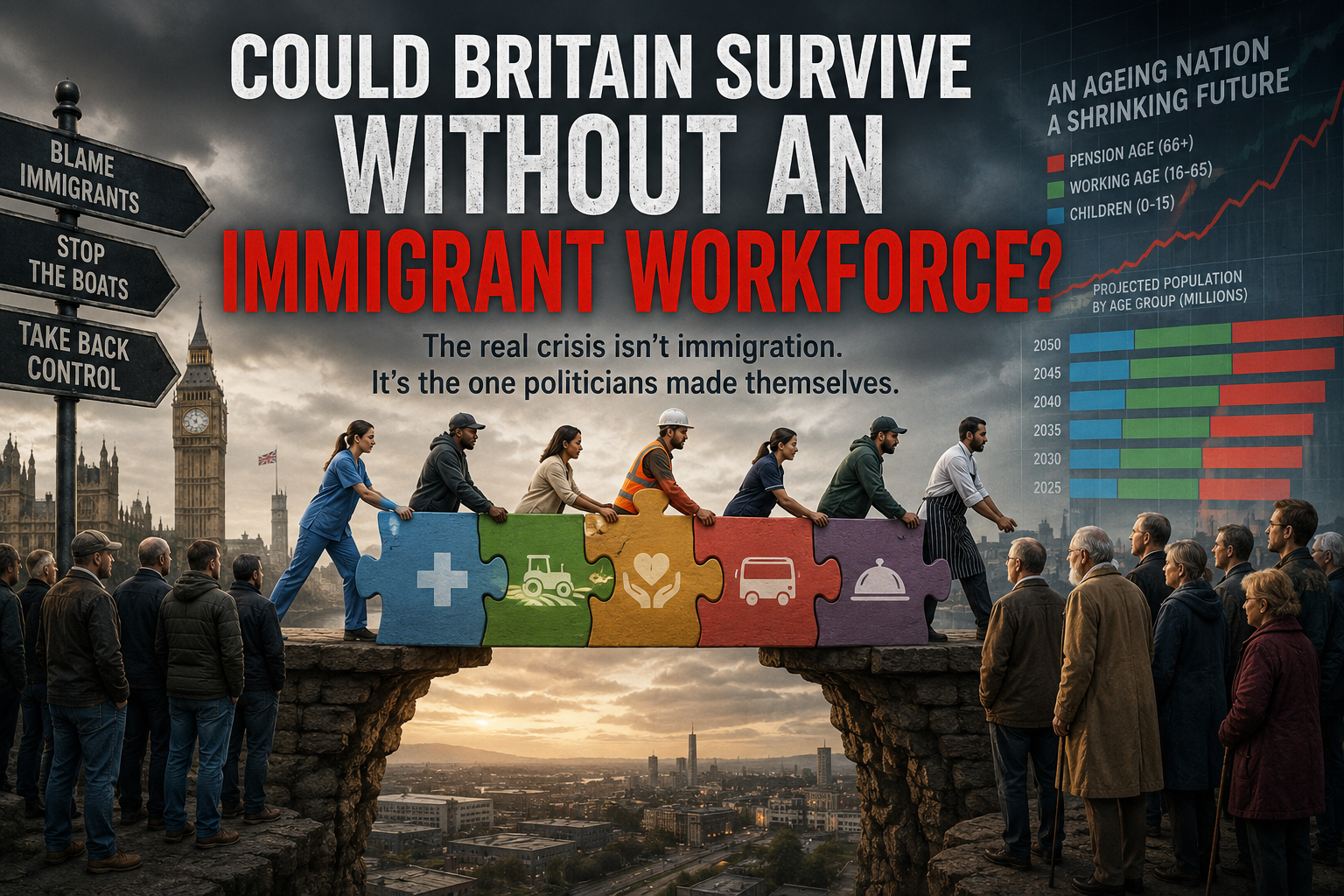
How immigration became Britain’s most convenient scapegoat
and why the real crisis is one politicians made themselves
The Central Argument
Britain has a problem. Its economy grows too slowly, its public services are under strain, its housing is unaffordable, and its workforce is ageing. These are real problems. But for more than a decade, a significant strand of British political thought has offered a single, simple explanation for all of them: immigrants.
First it was the Eastern Europeans, industrious, numerous, and conveniently foreign. Then, as free movement ended with Brexit and the Polish and Romanian workers who had sustained entire industries quietly went home, the target shifted. Now it is the men in dinghies crossing the English Channel, African, Middle Eastern, predominantly Muslim, who are cast as the source of Britain’s woes. The face has changed. The scapegoat has not.
This article argues that immigration is being used as a political scapegoat for structural, demographic, and political failures that long predate mass migration and would not be solved even if every boat were stopped tomorrow. The evidence is not marginal. It is overwhelming. And the cost of pretending otherwise, in economic damage, in social division, and in the human lives treated as pawns in a culture war, is enormous.
The Brexit Bargain: What Was Promised
The 2016 referendum campaign was not, at its core, about trade policy or parliamentary sovereignty. Those were arguments made by lawyers and economists. What moved votes was a simpler proposition: there are too many of them, and they are taking what is yours.
Immigration was not merely a topic in the Brexit debate. It was the emotional engine. The official Vote Leave campaign’s most arresting poster depicted a queue of brown-skinned refugees beneath the words “BREAKING POINT.” The Leave campaign’s promise to “take back control” was, for millions of voters, a promise to take back control of who came to Britain.
The specific anxieties were real, even if the diagnosis was wrong. Eastern European workers, more than one million of them, roughly 3% of the UK working-age population, had arrived after the 2004 EU enlargement, had settled predominantly in areas with limited prior experience of immigration. Research at the University of Warwick confirmed what many working-class communities felt: that there had been “smaller wage growth at the lower end of the wage distribution and increased pressure on the welfare state, housing and public services” in those areas. These were not invented grievances. But they were grievances caused as much by the failure of government investment in those communities as by the arrival of migrant workers.1Boffy-Ramirez, E. et al., Has Eastern European Migration Impacted UK-born Workers?, University of Warwick / CAGE Working Paper, 2018. Available at: warwick.ac.uk
By the time of the Brexit vote, the number of EU citizens moving to the UK was already falling, partly because wages at home in Eastern Europe had risen sharply — the British pound bought more than seven Polish zlotys in 2004, but less than five by 2018. The problem politicians promised to solve was already correcting itself. What Brexit delivered was not controlled migration. It was a different kind of immigration crisis: one of shortage rather than surplus.2BBC News, EU migration: How has it changed the UK?, 17 September 2018. Available at: bbc.co.uk/news/uk-45565124
The Target Has Shifted, But the Logic Has Not
After Brexit, the movement of Eastern European workers to Britain effectively ended. The nurses, fruit pickers, lorry drivers, hotel cleaners, and care workers who had formed the backbone of key sectors were gone, or going. Business owners who had once complained about “too many foreigners” were now advertising desperately in Romanian newspapers.3The Irony of Brexit: Why Britain Now Needs Central and Eastern European Workers More Than Ever, YouTube / economic commentary, 8 October 2024. Available at: youtube.com/watch?v=lc59ZnE7SzM
The political energy around immigration did not dissipate. It found a new object. The focus shifted, almost seamlessly, from the EU worker in a high-vis jacket to the asylum seeker on a rubber dinghy. Suella Braverman, as Home Secretary, described the English Channel crossings as an “invasion”. Rishi Sunak’s defining domestic policy pledge was to “Stop the Boats.” Reform UK’s Nigel Farage built an entire political identity on the image of dangerous men from “backward countries” slipping ashore to exploit British hospitality.4The Guardian, How far-right rhetoric on migration went mainstream, 19 August 2025. Available at: theguardian.com5Labour Outlook / Sabby Dhalu, Starmer’s immigration speech — emboldening the far-right, 23 May 2025. Available at: labouroutlook.org
This was not a policy response to a new reality. It was the same political reflex applied to a new face. The crucial distinction, that small boat arrivals and Eastern European labour migrants are almost entirely different categories of people, governed by entirely different legal frameworks, was deliberately obscured. The Channel crossings became a symbol of uncontrolled migration generally. The asylum seeker became the immigrant. The immigrant became the problem. The problem could always be fixed if only politicians were willing to be sufficiently ruthless. And if things did not improve, it was because those politicians had not been ruthless enough.
The Real Numbers: Separating Fact from Rhetoric
UK Net Migration 2018-2025
Before any rational policy debate is possible, the figures must be disentangled. The conflation of legal migration, student visas, asylum claims, small boat arrivals, and visa overstays is not an accident. It is a feature of the political argument. So here are the facts.
Putting Small Boat Arrivals into Context (2024)
Note: A log scale has been used on this chart as the values for Small Boat Crossings and Asylum Requests are so small that the bar chart will not even display them relative to the larger statistics in a linear scale.
That having been said, quite simply the bars should not be taken as a proportionate representation.
Net migration reached a record high of around 944,000 in the year ending March 2023, driven overwhelmingly by legal arrivals on work and student visas, many of whom came to fill critical shortages in health and social care. By the year ending December 2024, net migration had fallen to approximately 345,000 — a record annual decline. The most recent ONS figures, published in May 2026, confirm net migration for the year ending December 2025 at just 171,000 — down 48% year on year and the lowest level since the early stages of the post-Brexit immigration system, representing a fall of three-quarters of a million from the 2023 peak.6Office for National Statistics, International Migration (provisional estimates), updated June 2026. Available at: ons.gov.uk/peoplepopulationandcommunity/populationandmigration/internationalmigration7ONS Blog, Net migration continues to fall, 21 May 2026. Available at: blog.ons.gov.uk/2026/05/21/net-migration-continues-to-fall8European Information Network (EIN), 2024’s record fall in net migration was steeper than first estimated — revised ONS figures, 17 November 2025. Available at: ein.org.uk
Small boat crossings in the year ending March 2026 totalled 43,806 detected arrivals via illegal routes, with small boats accounting for 90% of those — a real number, but one that must be seen in context. In 2024, 132.3 million arrivals were recorded to the UK overall, making small boat arrivals a fraction of a percent of total arrivals. Since records began in 2018, more than 150,000 people in total have arrived by small boat — a figure smaller than the number of international students at a handful of major UK universities. The trend in 2026 is falling sharply: between January and June 2026, just 11,638 people crossed — down 37% on the same period the previous year.9BBC News, UK net migration drops to 171,000 — lowest since Covid pandemic, 21 May 2026. Available at: bbc.co.uk/news/articles/clyp1ekd584o10BBC News, Tracking UK migration: Small boats, asylum hotels and visas, updated 2026. Available at: bbc.co.uk/news/articles/c246ndy63j9o11Home Office, Summary of latest statistics — Immigration system statistics, year ending December 2024, 26 February 2025. Available at: gov.uk/government/statistics/immigration-system-statistics-year-ending-december-2024
Asylum claims reached 108,000 in 2024, a record high, but one driven by a backlog and processing delays as much as by new arrivals. By the year ending December 2025 asylum claims had dropped by 4%, and the number of asylum seekers housed in hotels had fallen to 30,657 — down 19% year on year. The number claiming asylum says nothing about the number being granted it, nor about the economic contribution of those who eventually receive leave to remain.12BBC News Live, UK asylum claims drop slightly in 2025 as small boat arrivals rise by 13%, 26 February 2026. Available at: bbc.co.uk/news/live/c363k7xj9k5t13Home Office, Summary of latest statistics — Immigration system statistics, year ending December 2024, 26 February 2025. Available at: gov.uk/government/statistics/immigration-system-statistics-year-ending-december-2024
Enforced returns numbered 8,200 in 2024, a figure that gives some measure of the vast gap between political rhetoric about deportation and operational reality.14Home Office, Summary of latest statistics — Immigration system statistics, year ending December 2024, 26 February 2025. Available at: gov.uk/government/statistics/immigration-system-statistics-year-ending-december-2024
These categories are legally, administratively, and economically distinct. Treating them as interchangeable, as most political rhetoric does, is not a simplification. It is a distortion.
What Brexit Actually Did to the Economy
The central claim of the Brexit campaign was that leaving the EU would make Britain more prosperous. The evidence, by 2026, is unambiguous in the other direction.
Estimated Brexit Economic Damage vs Counterfactual
By 2025, Brexit had reduced UK GDP per capita by an estimated 6–8% compared to a counterfactual in which the UK remained in the EU. Investment had fallen by 12–18%, employment by 3–4%, and productivity by 3–4%. The OBR, the government’s own independent fiscal watchdog, had already forecast a long-run 4% decline in national income and a 15% reduction in trade as a result of leaving the single market. More than 60% of the British public now believe Brexit has not gone well, including around a third of those who voted Leave.15CEPR / VoxEU, Brexit’s slow-burn hit to the UK economy, 4 December 2025. Available at: cepr.org/voxeu/columns/brexits-slow-burn-hit-uk-economy16National Bureau of Economic Research, The Economic Impact of Brexit (Working Paper 34459), November 2025. Available at: nber.org/papers/w3445917The Guardian, How has Britain’s economy fared since Brexit? The five charts underpinning the UK-EU summit, 19 May 2025. Available at: theguardian.com/business/2025/may/19
Before the referendum, the UK had the highest GDP growth rate in the G7. Since the vote, it has consistently ranked at or near the bottom. Output per worker has stagnated, and the gap between UK productivity and the OECD average has widened. The pound fell from $1.50 to $1.33 on referendum night alone — its largest single-day drop since the 1970s — importing inflation into every aspect of the British economy.18UK in a Changing Europe / Josh De Lyon and Swati Dhingra, UK economy since the Brexit vote: slower growth, lower productivity and a weaker pound, 30 November 2022. Available at: ukandeu.ac.uk
These are not the consequences of immigration. They are the consequences of severing trade relationships with 27 neighbouring countries, erecting new barriers to goods and services, and driving away the very workers — European migrants — whose labour had supported growth for two decades.
The Sectors That Cannot Function Without Migrant Workers
Sectors Most Dependent on Migrant Workers (%)
The question of whether Britain could “survive” without immigrant workers is not theoretical. It is being tested in real time, with painful consequences, in sector after sector.
Health and Social Care
Non-British NHS Staff Rise (2014-2024)
A fifth of all NHS England staff are non-British nationals. Among the approximately 1.5 million people working for NHS England, around 325,000 hold foreign nationalities, drawn from more than 200 countries. The percentage has risen from under 10% a decade ago to over 20% by 2024. In the most acute example of the dependency, overseas nurses arriving in the UK fell by 93% in three years — from 26,100 in 2022 to just 1,777 in 2025, a collapse in supply that health experts described as a “car crash” for hospitals and care homes.19BBC News, NHS over-reliant on overseas staff, health chiefs warn, 5 March 2025. Available at: bbc.co.uk/news/articles/cwyepe92210o20Yahoo News / Home Office data analysis, How many migrants work in the NHS?, 30 September 2025. Available at: uk.news.yahoo.com21The Guardian, Drop in overseas workers is ‘car crash’ for UK hospitals and care homes, say experts, 26 February 2026. Available at: theguardian.com/society/2026/feb/26
The government’s own NHS long-term plan had aspirations to keep the overseas-trained share of staff between 9% and 11%. The reality has long since outrun the target. Cutting foreign NHS workers now would not free up jobs for British workers. There are no British workers available to fill them. The UK simply does not train enough doctors, nurses, and care workers to meet demand, a structural failure of workforce planning that no amount of rhetoric about Channel boats can fix.22Yahoo News / Home Office data analysis, How many migrants work in the NHS?, 30 September 2025. Available at: uk.news.yahoo.com
Agriculture and Food Production
Estimated UK farm business closures since Brexit
Before Brexit, 99% of seasonal agricultural workers in the UK came from EU countries. After Brexit, that supply collapsed. Crops rotted in fields. A quarter of the UK daffodil crop went unpicked in a single season. Farmers lost hundreds of thousands of pounds in unharvested produce. The government issued 30,000 seasonal worker visas in 2021, but the horticultural industry needed between 80,000 and 90,000 workers. Parliamentary committees warned of “permanent damage” to British food production if the shortages were not addressed.23BBC News, UK labour shortage: ‘It used to be easy to get fruit pickers’, 24 May 2022. Available at: bbc.co.uk/news/uk-england-suffolk-6156828624Food and Drink Federation, Establishing the Labour Availability Issues of the UK Food and Drink Manufacturing Sector, August 2021. Available at: fdf.org.uk25Sky News, Labour shortages leave tonnes of food unpicked on British farms, 3 July 2022. Available at: news.sky.com26BBC News, Farming labour shortage could mean price rises, MPs warn, 5 April 2022. Available at: bbc.co.uk/news/science-environment-6099923627Institute of Export and International Trade, Post-Brexit labour shortages could lead to ‘permanent damage’ to UK food and farming, 5 April 2022. Available at: export.org.uk
The industries most proportionally dependent on migrant labour, transport and communications, manufacturing, wholesale and retail, together employed around 1.5 million non-UK nationals before Brexit. No political programme for restricting immigration has ever explained, credibly, how those roles would be filled by British workers who, in most cases, have no interest in doing them.28Brexit FactBase, Migrant workers and sectors, updated June 2026. Available at: brexitfactbase.com/6-immigration/migrant-workers-and-sectors
Hospitality and London
In London, 64% of hospitality roles are held by non-UK employees. Across the capital, 43% of all employee jobs are held by non-UK nationals. The city’s restaurants, hotels, bars, and coffee shops are staffed overwhelmingly by people who were not born in Britain. This is not because employers prefer foreigners. It is because the labour market, left to function, allocates workers to jobs. And the jobs that need filling are being filled by people willing to fill them.29Migration Observatory, University of Oxford, Migrants in the UK Labour Market: An Overview, updated May 2026. Available at: migrationobservatory.ox.ac.uk
The Fiscal Contribution: What Immigrants Actually Cost and Earn
The political claim that immigration is a drain on public resources does not survive contact with the evidence.
A study by Oxford Economics found that the average European migrant living in the UK contributed approximately £2,300 more to public finances per year than the average UK adult. Over their lifetime, the average European migrant arriving in 2016 was estimated to make a net positive contribution of £78,000 to the public exchequer. The migrants who arrived in 2016 alone were projected to make a total net positive contribution of £26.9 billion to UK public finances.30Oxford Economics, The Fiscal Impact of Immigration on the UK, September 2018. Available at: oxfordeconomics.com/resource/the-fiscal-impact-of-immigration-on-the-uk31Scottish Government / UK Government analysis, UK immigration policy after leaving the EU: impacts on Scotland’s economy, population and society — Fiscal Effects, February 2019. Available at: gov.scot
The OBR, in its own fiscal modelling, estimated that new migrants contribute around £19,500 per year in general taxation as workers, consumers, and residents, close to the average UK adult. They also pay around £1,900 in visa fees and £2,600 in Immigration Health Surcharge on arrival, generating £4.1 billion per year in direct revenue. Crucially, most migrants are ineligible for most welfare benefits during their first five years in the UK, meaning they contribute more and draw less than the political rhetoric suggests.32Office for Budget Responsibility, The impact of migration on the fiscal forecast, October 2024. Available at: obr.uk/box/the-impact-of-migration-on-the-fiscal-forecast
The Claim That Immigrants Take British Jobs
This is probably the single most persistent claim in British immigration politics. It is also, consistently, one of the least supported by evidence.
Research from Oxford, the LSE, and the National Institute of Economic and Social Research all found no significant impact of immigration on the employment or unemployment of UK-born workers. BBC Reality Check concluded that “non-UK workers have no effect on the employment of UK-born workers, except during an economic downturn”, and even then the effect is modest, temporary, and concentrated among the lowest-skilled workers.33BBC News Reality Check, Do foreign workers take jobs and cut wages?, 5 October 2016. Available at: bbc.co.uk/news/business-3757762034InFacts, EU immigrants aren’t taking Brits’ jobs, 26 July 2016. Available at: infacts.org/mythbusts/eu-immigrants-arent-taking-brits-jobs
The reason is straightforward: the labour market is not a fixed pie. As the economist Jonathan Portes has noted, when a migrant takes a job, a British worker cannot take that specific job, but it does not follow that the British worker will not find another. Migrants also spend money, pay taxes, use services, and generate demand, all of which creates jobs. Between 2013 and 2016, the number of EU workers in the UK rose by 700,000, yet the number of British workers in employment rose by one million in the same period.35The Guardian, Are EU migrants really taking British jobs and pushing down wages?, 20 May 2016. Available at: theguardian.com/politics/2016/may/20
The claim that EU migrants were depressing wages for British workers had more substance at the lower end of the wage distribution, but the remedy was not deportation. It was stronger labour regulation, higher minimum wages, and better enforcement. The government chose not to pursue those policies. It preferred to blame the workers rather than fix the rules.36Boffy-Ramirez, E. et al., Has Eastern European Migration Impacted UK-born Workers?, University of Warwick / CAGE Working Paper, 2018. Available at: warwick.ac.uk
An Ageing Nation: The Demographic Time Bomb
The immigration debate is being conducted against a backdrop that politicians of every stripe prefer not to discuss: Britain is getting old, fast, and the workforce is not growing quickly enough to support the people who are not working.
UK Ageing Population Projection (2025-2050)
By 2050, one in four people in the UK will be aged 65 or over. The number of people aged 65 or older is projected to increase by 34%, from 13.4 million in 2025 to 18 million by 2050, while the working-age population will grow by just 1%. Currently there are around 280 people above pension age for every 1,000 people of working age; by mid-2045, that ratio is projected to rise to 341 per 1,000. The ratio of working-age people to seniors is expected to fall from 3.1 to 2.4.37ONS, Living longer and old-age dependency — what does the future hold?, 23 June 2019. Available at: ons.gov.uk38ICAEW Insights, Chart of the week: more people living longer, 17 June 2026. Available at: icaew.com39Intergenerational Foundation, 2024 Ageing Factsheet, January 2025. Available at: if.org.uk40Wikipedia / ONS sources, Ageing of the United Kingdom. Available at: en.wikipedia.org/wiki/Ageing_of_the_United_Kingdom
This matters enormously for public finances. State pensions, the NHS, and social care are paid for primarily by the taxes of working people. As the number of workers relative to pensioners falls, either taxes must rise, services must be cut, or the workforce must be replenished. There are three ways to do the latter: encourage more British people into work, raise the retirement age, or maintain immigration.
The ONS has modelled the mathematics bluntly: to keep the old-age dependency ratio constant, the state pension age would need to rise to 68 in the first half of the 2030s, 69 in the late 2030s, and 70 by the 2040s. These are not comfortable numbers. They are the structural reality that immigration rhetoric papers over.41ONS / UK Statistics Authority, Follow-up correspondence to the Lords Economic Affairs Committee — Preparing for an Ageing Society, March 2025. Available at: uksa.statisticsauthority.gov.uk
The Impossible Promise: Mass Deportation
Reform UK, under Nigel Farage, has promised to deport up to 600,000 people in a single Parliament. To achieve this, the party proposes withdrawing from the European Convention on Human Rights, repealing the Human Rights Act, disapplying the 1951 Refugee Convention for five years, abolishing the right to appeal against deportation, and building mass detention camps capable of holding 24,000 people.42Reuters, Farage’s Reform pledges tougher UK residency rules, 22 September 2025. Available at: reuters.com/world/uk/farages-reform-pledges-tougher-uk-residency-rules-2025-09-2243WSWS, Reform UK leader Farage unveils mass migrant deportations plan, 26 August 2025. Available at: wsws.org
The Cost of Deportation vs Keeping Asylum Seekers
Even setting aside the legal and moral catastrophe this would represent, the operational reality makes it implausible. The UK currently manages around 8,200 enforced returns per year. To reach 600,000 deportations in five years would require increasing that capacity by roughly 1,400%. The estimated cost of comprehensive mass deportation in Britain runs to between £20 billion and £35 billion, potentially exceeding the entire Home Office annual budget. Detention alone costs £122 per person per day; charter deportation flights run to approximately £500,000 each and carry 40–50 people, yielding a per-person flight cost of £10,000–12,500.44The State of the Mind, Mass deportation price tag: roughly £20–35 billion, with years of gridlock, 26 September 2025. Available at: thestateofthemind.com45Home Office, Summary of latest statistics — Immigration system statistics, year ending December 2024, 26 February 2025. Available at: gov.uk
The government’s own assessment of the Rwanda scheme — one of the most aggressively marketed deportation policies in recent British history — found that it would cost £169,000 to remove each asylum seeker, against a saving of £106,000 in housing support if they remained. Removing the average asylum seeker would, on those figures, cost the taxpayer £63,000 more than letting them stay.46BBC News / House of Commons Library, Cost to remove a migrant £63,000 more than keeping in UK, 26 June 2023. Available at: bbc.co.uk/news/uk-politics-66022219
The academic consensus, reflected in the Home Office’s own documents, is that there is “little to no evidence suggesting changes in a destination country’s policies have an impact on deterring people from leaving their countries of origin”. People do not risk their lives crossing the Channel because Britain has generous immigration rules. They risk their lives because they are fleeing circumstances that no British government policy can alter.47University of York, The far-right and migration politics in the aftermath of the 2024 riots, published November 2025. Available at: pure.york.ac.uk
The Real Problems: Structural, Not Migratory
Britain’s genuine economic problems, sluggish productivity growth, under-investment, an overheating housing market, and overstretched public services, all predate recent immigration waves and have structural explanations that have nothing to do with the nationality of the workforce.
The housing crisis is a case in point. England has approximately 4.3 million social homes in 2024, 1.2 million fewer than in 1981, when the stock peaked. The decline was caused by Right to Buy (which removed at least 1.9 million homes from social stock since 1980), chronic under-investment in new social housing, and the treatment of residential property as a financial asset rather than a social good. There is no evidence of a causal connection between immigration and a lack of available accommodation. Around 74% of recent migrants live in privately rented accommodation, and 91% of new social tenancies are granted to UK-born citizens.48The Longer Look, UK Migration — Housing Supply, 10 May 2026. Available at: thelongerlook.com49The Conversation, Election 2024: migrants aren’t to blame for Britain’s housing crisis, 2024. Available at: theconversation.com50Howard Kennedy Insights, Migrants are not to blame for Britain’s housing crisis, 16 June 2026. Available at: insights.howardkennedy.com
Productivity stagnation began long before recent immigration levels and has multiple causes: low business investment, under-developed infrastructure, a skills gap, and, now confirmed, the economic drag of Brexit itself. Wage pressure at the lower end is real, but the cause is the weakness of labour regulation and trade union power, not the presence of foreign workers.51Cambridge University Press / National Institute Economic Review, Understanding the Effects of Brexit on UK Productivity, May 2024. Available at: cambridge.org/core52CEPR / VoxEU, Brexit’s slow-burn hit to the UK economy, 4 December 2025. Available at: cepr.org
The Social Cost of the Scapegoat
Words have consequences. Research by HOPE not Hate found a 149% increase in messages on anti-migrant far-right channels between 2021 and early 2023. When Suella Braverman described Channel crossings as an “invasion,” the word “invasion” spiked by 52% on far-right Telegram channels within days. Government announcements on Rwanda were associated with 72% increases in anti-migrant messaging.53Scottish Refugee Council / HOPE not Hate, Research reveals link between government’s anti-migrant rhetoric and far-right activity, May 2023. Available at: scottishrefugeecouncil.org.uk
The 2024 summer riots, sparked by a mass stabbing in Southport and fanned by deliberate misinformation about the perpetrator’s immigration status, were the most vivid expression of what this kind of sustained rhetoric produces. Senior politicians, including former Conservative ministers, acknowledged that years of demonising asylum seekers and the legal profession had “prepared the ground”. Even Keir Starmer’s May 2025 “Island of Strangers” speech, with its echoes of Enoch Powell’s 1968 language about people finding themselves “strangers in their own country”, was criticised by civil society organisations for reinforcing the same harmful framing, positioning migrants as scapegoats for systemic failures rather than as contributors to the society they had joined.54The Irish Times, Conservative rhetoric on migrants helped prepare ground for far-right riots, say campaigners, 7 August 2024. Available at: irishtimes.com55Labour Outlook / Sabby Dhalu, Starmer’s immigration speech — emboldening the far-right, 23 May 2025. Available at: labouroutlook.org
The language of invasion, infestation, and flood does not stay in the speech. It ends up in the street. It ends up directed at settled British communities, British citizens of South Asian, African, and Caribbean heritage, who have nothing to do with Channel crossings but who happen to have the wrong skin colour or the wrong religion to be left alone once the mob is looking for a target.
What a Rational Policy Looks Like
None of this is an argument for unlimited, unmanaged immigration. No serious person advocates that. Immigration policy requires genuine management: matching skills to needs, protecting wages, investing in integration, and processing asylum claims efficiently and humanely.
The UK’s net migration figures have already fallen dramatically, from a peak of 944,000 in early 2023 to 171,000 by the end of 2025, largely through visa tightening on students and care workers. The consequences are already visible: a 93% drop in overseas nurses, a social care sector facing a “car crash”, and a university sector that has lost a significant revenue stream. Managed reduction is possible. What is not possible, and what has never been attempted successfully in any democracy, is the elimination of immigration from a country with 42 million working-age people who cannot and will not do all the jobs that need to be done.56European Information Network (EIN), 2024’s record fall in net migration was steeper than first estimated — revised ONS figures, 17 November 2025. Available at: ein.org.uk57The Guardian, Drop in overseas workers is ‘car crash’ for UK hospitals and care homes, say experts, 26 February 2026. Available at: theguardian.com58Office for National Statistics, International Migration (provisional estimates), updated June 2026. Available at: ons.gov.uk
There are better models available. In June 2026, the government announced a new capped refugee sponsorship route — allowing universities, businesses, and community organisations to bring refugees to Britain legally, modelled on Canada’s long-established community sponsorship programme. A refugee work pathway is set to follow in 2027. Numbers will be small and carefully vetted, but the principle is sound: safe, legal, managed pathways that reduce the pressure on dangerous Channel crossings without pretending the global demand for asylum can simply be legislated away.59BBC News, Mahmood announces new refugee sponsorship route into UK, 26 June 2026. Available at: bbc.com/news/articles/c5yz952dm74o
The alternative to migrant workers in the NHS is not a Britain staffed by British nurses. It is a Britain that trains far more nurses, a decade-long investment that no government has yet committed to at the necessary scale. The alternative to migrant agricultural workers is not British fruit pickers. It is higher food prices, automated harvesting, and reduced domestic food production. The alternative to migrant care workers is not a generation of British twenty-somethings choosing careers wiping elderly patients in underpaid jobs. It is a social care crisis that is, in fact, already underway.
Conclusion: The Courage to Tell the Truth
Britain’s problems are real. The people who feel them most acutely, in left-behind towns, in oversubscribed GP surgeries, in a housing market that has priced out a generation, are not wrong to be angry. Their anger is legitimate. It is the target of that anger that has been deliberately misdirected.
The immigrants in the boats did not close the factories. They did not sell off the council houses. They did not cut Sure Start centres or freeze public sector pay for a decade. They did not vote for Brexit, negotiate trade deals that reduced export opportunities, or spend decades failing to invest in infrastructure, skills, and public services. These were choices made by British governments, supported by British voters, justified by British ideologues.
Demography is the most powerful force in long-run economics, and Britain’s demography is moving in one direction: older, slower, more dependent. By mid-century, the country will need every working-age person it can find, of whatever origin, to sustain the pensions, hospitals, and care homes that an ageing population will require. A politics that treats those workers as a threat, rather than a necessity, is not merely wrong. It is self-destructive.
The real question facing Britain is not whether it can survive without an immigrant workforce. The evidence makes the answer to that question reasonably clear. The real question is whether Britain’s political class has the courage to tell its voters the truth: that the crisis is structural, the scapegoat is false, and the solutions require investment, reform, and honesty, not a dinghy and a points total.
Sources & References
- 1Boffy-Ramirez, E. et al., Has Eastern European Migration Impacted UK-born Workers?, University of Warwick / CAGE Working Paper, 2018. Available at: warwick.ac.uk ↩︎
- 2BBC News, EU migration: How has it changed the UK?, 17 September 2018. Available at: bbc.co.uk/news/uk-45565124 ↩︎
- 3The Irony of Brexit: Why Britain Now Needs Central and Eastern European Workers More Than Ever, YouTube / economic commentary, 8 October 2024. Available at: youtube.com/watch?v=lc59ZnE7SzM ↩︎
- 4The Guardian, How far-right rhetoric on migration went mainstream, 19 August 2025. Available at: theguardian.com ↩︎
- 5Labour Outlook / Sabby Dhalu, Starmer’s immigration speech — emboldening the far-right, 23 May 2025. Available at: labouroutlook.org ↩︎
- 6Office for National Statistics, International Migration (provisional estimates), updated June 2026. Available at: ons.gov.uk/peoplepopulationandcommunity/populationandmigration/internationalmigration ↩︎
- 7ONS Blog, Net migration continues to fall, 21 May 2026. Available at: blog.ons.gov.uk/2026/05/21/net-migration-continues-to-fall ↩︎
- 8European Information Network (EIN), 2024’s record fall in net migration was steeper than first estimated — revised ONS figures, 17 November 2025. Available at: ein.org.uk ↩︎
- 9BBC News, UK net migration drops to 171,000 — lowest since Covid pandemic, 21 May 2026. Available at: bbc.co.uk/news/articles/clyp1ekd584o ↩︎
- 10BBC News, Tracking UK migration: Small boats, asylum hotels and visas, updated 2026. Available at: bbc.co.uk/news/articles/c246ndy63j9o ↩︎
- 11Home Office, Summary of latest statistics — Immigration system statistics, year ending December 2024, 26 February 2025. Available at: gov.uk/government/statistics/immigration-system-statistics-year-ending-december-2024 ↩︎
- 12BBC News Live, UK asylum claims drop slightly in 2025 as small boat arrivals rise by 13%, 26 February 2026. Available at: bbc.co.uk/news/live/c363k7xj9k5t ↩︎
- 13Home Office, Summary of latest statistics — Immigration system statistics, year ending December 2024, 26 February 2025. Available at: gov.uk/government/statistics/immigration-system-statistics-year-ending-december-2024 ↩︎
- 14Home Office, Summary of latest statistics — Immigration system statistics, year ending December 2024, 26 February 2025. Available at: gov.uk/government/statistics/immigration-system-statistics-year-ending-december-2024 ↩︎
- 15CEPR / VoxEU, Brexit’s slow-burn hit to the UK economy, 4 December 2025. Available at: cepr.org/voxeu/columns/brexits-slow-burn-hit-uk-economy ↩︎
- 16National Bureau of Economic Research, The Economic Impact of Brexit (Working Paper 34459), November 2025. Available at: nber.org/papers/w34459 ↩︎
- 17The Guardian, How has Britain’s economy fared since Brexit? The five charts underpinning the UK-EU summit, 19 May 2025. Available at: theguardian.com/business/2025/may/19 ↩︎
- 18UK in a Changing Europe / Josh De Lyon and Swati Dhingra, UK economy since the Brexit vote: slower growth, lower productivity and a weaker pound, 30 November 2022. Available at: ukandeu.ac.uk ↩︎
- 19BBC News, NHS over-reliant on overseas staff, health chiefs warn, 5 March 2025. Available at: bbc.co.uk/news/articles/cwyepe92210o ↩︎
- 20Yahoo News / Home Office data analysis, How many migrants work in the NHS?, 30 September 2025. Available at: uk.news.yahoo.com ↩︎
- 21The Guardian, Drop in overseas workers is ‘car crash’ for UK hospitals and care homes, say experts, 26 February 2026. Available at: theguardian.com/society/2026/feb/26 ↩︎
- 22Yahoo News / Home Office data analysis, How many migrants work in the NHS?, 30 September 2025. Available at: uk.news.yahoo.com ↩︎
- 23BBC News, UK labour shortage: ‘It used to be easy to get fruit pickers’, 24 May 2022. Available at: bbc.co.uk/news/uk-england-suffolk-61568286 ↩︎
- 24Food and Drink Federation, Establishing the Labour Availability Issues of the UK Food and Drink Manufacturing Sector, August 2021. Available at: fdf.org.uk ↩︎
- 25Sky News, Labour shortages leave tonnes of food unpicked on British farms, 3 July 2022. Available at: news.sky.com ↩︎
- 26BBC News, Farming labour shortage could mean price rises, MPs warn, 5 April 2022. Available at: bbc.co.uk/news/science-environment-60999236 ↩︎
- 27Institute of Export and International Trade, Post-Brexit labour shortages could lead to ‘permanent damage’ to UK food and farming, 5 April 2022. Available at: export.org.uk ↩︎
- 28Brexit FactBase, Migrant workers and sectors, updated June 2026. Available at: brexitfactbase.com/6-immigration/migrant-workers-and-sectors ↩︎
- 29Migration Observatory, University of Oxford, Migrants in the UK Labour Market: An Overview, updated May 2026. Available at: migrationobservatory.ox.ac.uk ↩︎
- 30Oxford Economics, The Fiscal Impact of Immigration on the UK, September 2018. Available at: oxfordeconomics.com/resource/the-fiscal-impact-of-immigration-on-the-uk ↩︎
- 31Scottish Government / UK Government analysis, UK immigration policy after leaving the EU: impacts on Scotland’s economy, population and society — Fiscal Effects, February 2019. Available at: gov.scot ↩︎
- 32Office for Budget Responsibility, The impact of migration on the fiscal forecast, October 2024. Available at: obr.uk/box/the-impact-of-migration-on-the-fiscal-forecast ↩︎
- 33BBC News Reality Check, Do foreign workers take jobs and cut wages?, 5 October 2016. Available at: bbc.co.uk/news/business-37577620 ↩︎
- 34InFacts, EU immigrants aren’t taking Brits’ jobs, 26 July 2016. Available at: infacts.org/mythbusts/eu-immigrants-arent-taking-brits-jobs ↩︎
- 35The Guardian, Are EU migrants really taking British jobs and pushing down wages?, 20 May 2016. Available at: theguardian.com/politics/2016/may/20 ↩︎
- 36Boffy-Ramirez, E. et al., Has Eastern European Migration Impacted UK-born Workers?, University of Warwick / CAGE Working Paper, 2018. Available at: warwick.ac.uk ↩︎
- 37ONS, Living longer and old-age dependency — what does the future hold?, 23 June 2019. Available at: ons.gov.uk ↩︎
- 38ICAEW Insights, Chart of the week: more people living longer, 17 June 2026. Available at: icaew.com ↩︎
- 39Intergenerational Foundation, 2024 Ageing Factsheet, January 2025. Available at: if.org.uk ↩︎
- 40Wikipedia / ONS sources, Ageing of the United Kingdom. Available at: en.wikipedia.org/wiki/Ageing_of_the_United_Kingdom ↩︎
- 41ONS / UK Statistics Authority, Follow-up correspondence to the Lords Economic Affairs Committee — Preparing for an Ageing Society, March 2025. Available at: uksa.statisticsauthority.gov.uk ↩︎
- 42Reuters, Farage’s Reform pledges tougher UK residency rules, 22 September 2025. Available at: reuters.com/world/uk/farages-reform-pledges-tougher-uk-residency-rules-2025-09-22 ↩︎
- 43WSWS, Reform UK leader Farage unveils mass migrant deportations plan, 26 August 2025. Available at: wsws.org ↩︎
- 44The State of the Mind, Mass deportation price tag: roughly £20–35 billion, with years of gridlock, 26 September 2025. Available at: thestateofthemind.com ↩︎
- 45Home Office, Summary of latest statistics — Immigration system statistics, year ending December 2024, 26 February 2025. Available at: gov.uk ↩︎
- 46BBC News / House of Commons Library, Cost to remove a migrant £63,000 more than keeping in UK, 26 June 2023. Available at: bbc.co.uk/news/uk-politics-66022219 ↩︎
- 47University of York, The far-right and migration politics in the aftermath of the 2024 riots, published November 2025. Available at: pure.york.ac.uk ↩︎
- 48The Longer Look, UK Migration — Housing Supply, 10 May 2026. Available at: thelongerlook.com ↩︎
- 49The Conversation, Election 2024: migrants aren’t to blame for Britain’s housing crisis, 2024. Available at: theconversation.com ↩︎
- 50Howard Kennedy Insights, Migrants are not to blame for Britain’s housing crisis, 16 June 2026. Available at: insights.howardkennedy.com ↩︎
- 51Cambridge University Press / National Institute Economic Review, Understanding the Effects of Brexit on UK Productivity, May 2024. Available at: cambridge.org/core ↩︎
- 52CEPR / VoxEU, Brexit’s slow-burn hit to the UK economy, 4 December 2025. Available at: cepr.org ↩︎
- 53Scottish Refugee Council / HOPE not Hate, Research reveals link between government’s anti-migrant rhetoric and far-right activity, May 2023. Available at: scottishrefugeecouncil.org.uk ↩︎
- 54The Irish Times, Conservative rhetoric on migrants helped prepare ground for far-right riots, say campaigners, 7 August 2024. Available at: irishtimes.com ↩︎
- 55Labour Outlook / Sabby Dhalu, Starmer’s immigration speech — emboldening the far-right, 23 May 2025. Available at: labouroutlook.org ↩︎
- 56European Information Network (EIN), 2024’s record fall in net migration was steeper than first estimated — revised ONS figures, 17 November 2025. Available at: ein.org.uk ↩︎
- 57The Guardian, Drop in overseas workers is ‘car crash’ for UK hospitals and care homes, say experts, 26 February 2026. Available at: theguardian.com ↩︎
- 58Office for National Statistics, International Migration (provisional estimates), updated June 2026. Available at: ons.gov.uk ↩︎
- 59BBC News, Mahmood announces new refugee sponsorship route into UK, 26 June 2026. Available at: bbc.com/news/articles/c5yz952dm74o ↩︎

 20
20