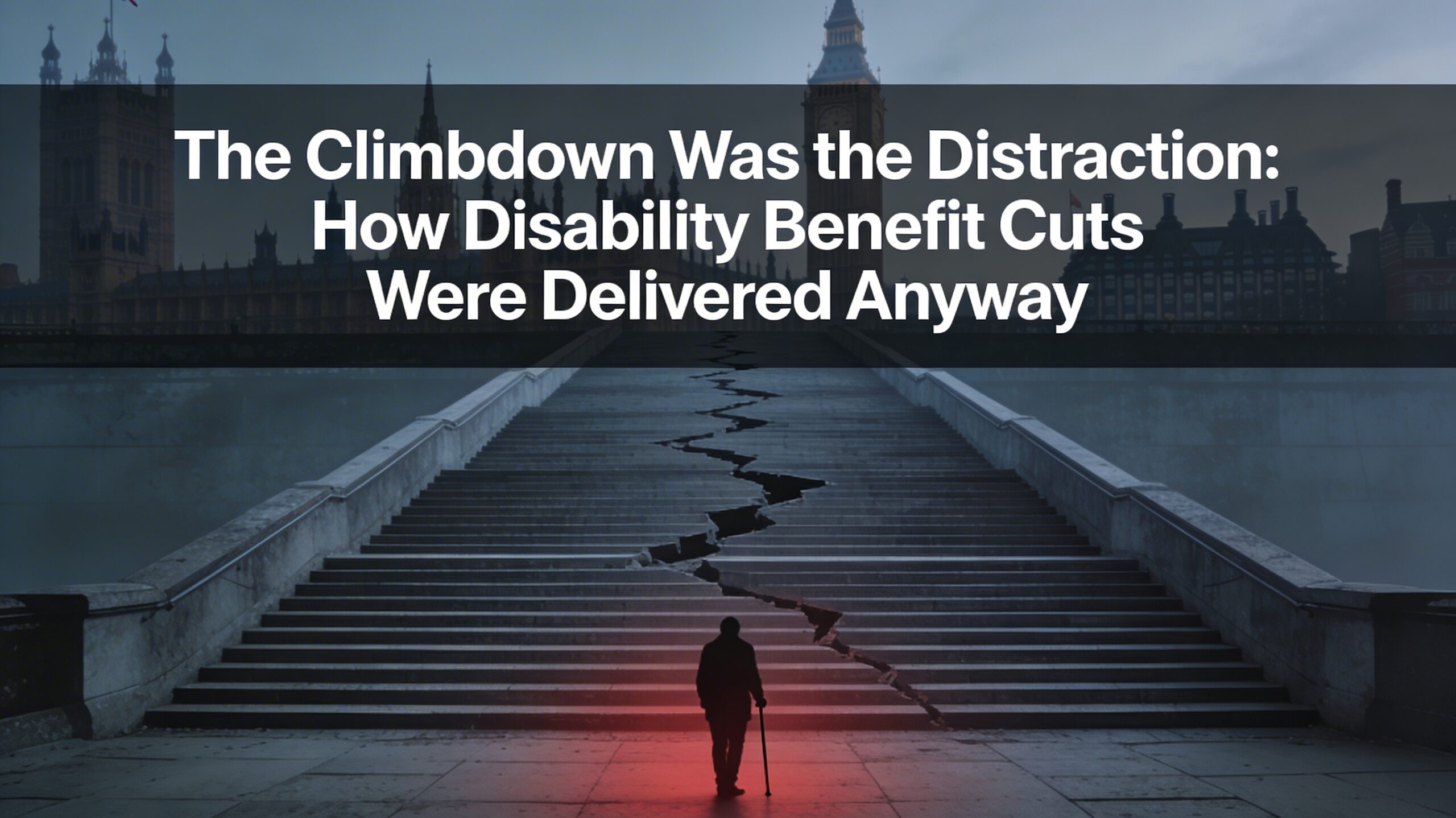
How Disability Benefit Cuts Were Delivered Anyway.
When the government announced its “climbdown” on disability benefit reforms last year, it was sold as a victory. Backbench rebellion had forced concessions, a review was promised, and the most controversial elements appeared to have been withdrawn.
That was the narrative.
It was not the outcome.
This is not a new concern. In my previous article, *“The government’s so-called climbdown on disability benefit cuts isn’t the victory it’s being sold as”*, I warned that the apparent retreat was unlikely to hold, and that the underlying direction of policy remained unchanged.
What followed was not a reversal of policy, but a repositioning. The political pressure was absorbed, the headlines moved on, and the reforms continued, quieter, more complex, and far less visible.
Reform Didn’t Stop. It Changed Shape.
The original proposals combined changes to both Universal Credit (UC) and Personal Independence Payment (PIP). Under pressure, the government removed the PIP elements.
But the rest of the bill remained, — and that is where the real impact now sits.
From April 2026, the UC health element has been fundamentally altered. New claimants assessed as having limited capability for work-related activity now receive roughly half the previous level of support, unless they meet the much stricter Severe Conditions Criteria (SCC).1Benefits and Work, “Savage severe conditions criteria (SCC) cuts have begun”, 9 April 2026.
In practice, this means:
-
Existing claimants retain around £429.80 per month.
-
New claimants without SCC receive around £217.26 per month.
-
A reduction of roughly £50 per week.2Benefits and Work, April 2026.
This is not a minor adjustment. It is a structural cut, delivered not through headline policy reversal, but through redesign.
The Gate Has Narrowed
The SCC now determines who receives full support.
To qualify, a claimant must show not only that they meet the existing criteria, but that their condition is lifelong and that the relevant descriptor will apply constantly for the rest of their life.3Benefits and Work, April 2026.
This is an exceptionally narrow definition.
It excludes many people with severe but fluctuating conditions, progressive illnesses, or any realistic possibility of improvement. It is no longer enough to be unable to work, it must be proven that this will never change.
The result is a system that quietly redefines who counts as “severely disabled”, not by medical reality, but by administrative threshold.
Same Need, Different Outcome
These changes introduce a clear dividing line.
Two people with identical conditions can now receive entirely different levels of support depending on when they become ill or when they claim. Those who fall ill after April 2026 are automatically worse off.
This is not based on need. It is based on timing.
What was presented as reform has, in practice, created a two-tier system.
The Story We Are Being Told
Alongside these changes, a familiar narrative has taken hold, that sickness benefits are widely abused, that they are an easy option, that large numbers of people are choosing not to work.
This claim is repeated often. It is rarely examined.
Because it does not reflect reality.
The framing of welfare as widely abused, and claimants as choosing dependency, sits squarely within the broader populist narrative examined in *“The Quiet War: Capital, Populism, and the Collapse of Consensus”*, where complex structural issues are reduced to simplified moral arguments about responsibility and blame.
The Reality of the System
Claiming disability related benefits is not simple. It is not quick. And it is not forgiving.
To get through the system, people must:
-
Gather detailed medical evidence from healthcare professionals who are already overstretched, often over many months.
-
Complete lengthy and complex application forms that demand precise, almost legalistic descriptions of how conditions affect daily life.
-
Navigate inconsistent or unavailable advice and support, frequently doing it alone.
-
Travel, sometimes long distances, for assessments, even when their health makes this extremely difficult.
-
Challenge high rates of error in initial decisions, through mandatory reconsiderations and often through tribunal appeals.
It is not uncommon for it to take a year or more before a correct decision is reached and payment begins.
This is not a system that invites abuse.
It is a system that filters people out.
A More Likely Explanation
If we are seeing an increase in sickness and disability claims, there is a more credible explanation than widespread exploitation.
People are getting sicker.
Years of pressure on the NHS have led to long waiting lists, reduced access to GPs, and the collapse of NHS dentistry in many areas. Increasingly, people delay seeking treatment until conditions become severe. Others struggle to access consistent care at all.
Manageable conditions deteriorate. Mental health worsens. Preventable issues become disabling.
The system is not being overwhelmed by people choosing not to work.
It is being overwhelmed by unmet health need.
A System Already Among the Least Generous
These reforms are taking place against an already stark backdrop.
Even before these changes, the UK ranked near the bottom among wealthy countries in terms of working age and disability benefit generosity. Replacement rates, the proportion of previous earnings replaced by benefits, were already among the lowest in the OECD.4OECD data, 2025.
The current cuts, expected to save around £3.4 billion annually, are targeted at a relatively small group, sick and disabled claimants.5UK Government Spring Statement analysis, 2025. They do not significantly reduce overall welfare spending. They reduce support where it is already weakest.
By the end of the decade, the UK is expected to sit firmly among the least generous systems in the developed world for sickness and disability support.6OECD comparative analysis.
The Claim That It Will Drive Work
The justification for all of this remains the same, that reducing support will encourage people into employment.
But the evidence for this is weak.
Independent analysis consistently finds that any employment gains are likely to be modest, while income losses are substantial and poverty increases. Most disabled people are not out of work because they lack motivation. They are out of work because they are ill.
Reducing support does not change that.
The Cost Does Not Disappear
What happens when support is reduced?
The need does not vanish. It shifts.
Families take on greater care responsibilities. Some give up work entirely to support relatives who can no longer manage independently. The NHS faces increased demand as financial stress worsens health outcomes. Local authorities, already under strain, absorb rising need.
Small local businesses, often providing essential services, lose income as those who rely on them can no longer afford to do so.
This is not a saving.
It is a redistribution of cost, away from central government and onto everyone else.
This is not a new observation. In *“Why Proposed PIP Cuts Could Trigger a Council Tax Crisis”*, I set out in detail how reducing central support does not remove cost, it shifts it onto local authorities, public services, and ultimately the taxpayer.
Law, Process, and Reality
Legally, there are limits to how far the system can go.
In RA v Secretary of State for Work and Pensions UKUT 207 (AAC), the Upper Tribunal confirmed that entitlement to Universal Credit is a legal decision that cannot simply be erased without proper process.7RA v Secretary of State for Work and Pensions (Universal Credit): UKUT 207 (AAC).
But law and lived experience are not the same thing.
As scrutiny increases and systems become more demanding, claimants are likely to face more checks, more reassessment, and greater pressure to justify their circumstances. Even where the law places the burden on the state, the experience increasingly places it on the individual.
This growing gap between formal legal protections and lived experience reflects a wider erosion of institutional safeguards, a theme explored in *“Our Democracy Under Siege”*, where procedural change and reduced scrutiny increasingly shape outcomes without overt political confrontation.
This increasing centralisation of decision-making, combined with reduced transparency, mirrors wider trends in governance discussed in *“Can We Really ‘Tear Down’ Bureaucracy for Efficiency?”*, where reforms presented as efficiency measures often result in greater concentration of power rather than improved outcomes
What the Climbdown Really Achieved
The climbdown did not stop the reforms.
It removed the most politically explosive elements, reduced immediate pressure, and allowed the rest to proceed with less attention. What looked like a retreat was, in reality, a repositioning.
The system has been reshaped.
Support has been reduced.
And the consequences are already beginning to unfold.
This fits into a broader pattern in modern policy, where visible conflict is followed by quieter structural change. As explored in *“The Quiet War: Capital, Populism, and the Collapse of Consensus”*, many of the most significant shifts are no longer dramatic, but incremental, embedded in systems rather than headlines
Conclusion
There was no single moment when support was dramatically cut. There was no clear line where the system changed overnight.
Instead, there has been a gradual tightening, a narrowing of eligibility, a reduction in support delivered through structure rather than headline.
For those affected, the distinction does not matter.
The outcome is the same.
Less support. More pressure. Greater uncertainty.
A system that demands more, while providing less.
The climbdown was the headline. The cuts were the story that followed, unseen, but decisive.
Sources & References
- 1Benefits and Work, “Savage severe conditions criteria (SCC) cuts have begun”, 9 April 2026. ↩︎
- 2Benefits and Work, April 2026. ↩︎
- 3Benefits and Work, April 2026. ↩︎
- 4OECD data, 2025. ↩︎
- 5UK Government Spring Statement analysis, 2025. ↩︎
- 6OECD comparative analysis. ↩︎
- 7RA v Secretary of State for Work and Pensions (Universal Credit): UKUT 207 (AAC). ↩︎

 20
20